The app · in beta

The missing brain for your home's energy.

Powermind watches your solar and your appliances in real time, and quietly runs your hot water, car and aircon on your own sunshine instead of the grid — then tells you exactly what it did, and proves what it saved. No expensive box, no battery needed to start. It works with the devices you already own.

Software first

It works with the devices you already own.

Powermind is software, not a box on the wall. For most homes there's nothing to buy — it reads your existing solar monitor and appliances through their own connections, works out your live surplus (the solar heading to the grid right now), and coordinates who uses it. Where an older device needs a hand — say a hot-water system that can't report its own energy use — a small energy meter (around $99, fitted by a sparky) gives Powermind an accurate read on what it's actually using. The goal is hardware-free: no expensive proprietary box, no battery needed to get started, no lock-in. You add only what genuinely earns its place.

How it works
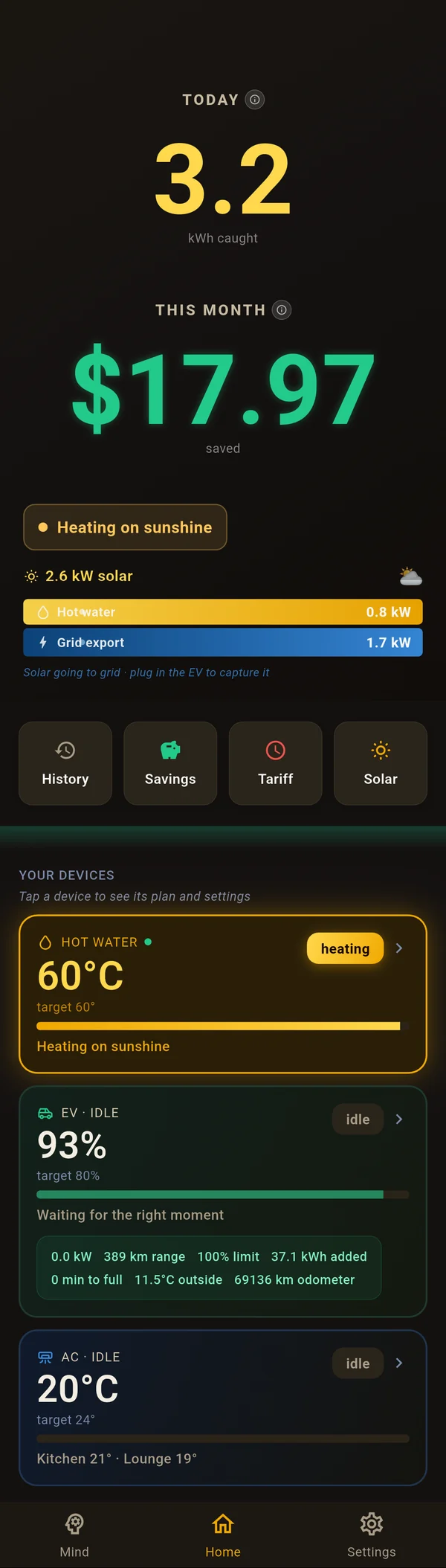
The Powermind app — today's solar caught, savings, and connected devices

A working build in testing — hot water is automated; the car and aircon are still learning. Figures shown are preliminary.

1

It watches

Reads your solar surplus every 45 seconds — how much is spare right now, not going to the house or the car, just heading to the grid for cents.

2

It decides

Scores which device needs that solar most — how much it'd otherwise cost, how urgent its deadline is, whether the surplus is worth committing to — weighing your tariff windows against the forecast.

3

It acts

Nudges the right device on — heats your water, charges the car, pre-cools the house — calmly, without chasing every passing cloud, then explains what it did and why.

The Mind

It thinks out loud. In plain English.

Powermind isn't a solar diverter following a timer. Every decision weighs your surplus, your tariff, your deadlines and the day's forecast — and it tells you the single most important thing it's doing right now, and why. Not a wall of data. A reason.

Catching the spare sun
2.4 kW spare right now, tank at 52°. Heating your water on free solar instead of buying it back tonight.
Hot water · now
Peak rate till 8pm — holding off
Your water's warm enough to wait. It'll top up on cheap off-peak, or tomorrow's sun.
Hot water · 5:12pm
Car needs 80% by 8am
Not enough sun left today — booking the charge for 11pm, when off-peak starts.
EV · 9:40pm
Pre-cooling before the peak
Strong surplus and a hot afternoon forecast — cooling the house now so it coasts through the 5pm peak.
Aircon · 2:05pm
Hot water's ready
Hit your 6pm deadline on solar alone today — no grid power needed.
Hot water · 3:20pm
Surplus too small to act
0.3 kW spare — below the line to run anything usefully. On watch.
11:35am

Each line is the real reason behind a real decision — the same logic that made it, not a label bolted on afterwards.

It learns your home

It gets smarter the longer it lives with you.

Powermind keeps a quiet record of every decision and what happened, and uses it to tune itself to your home in particular — the same proven approach a smart thermostat like Nest takes. The longer it runs, the sharper and more efficient it gets.

Hot water

Your tank's real speed

It learns exactly how fast your tank heats and how slowly it cools. So it can leave the heating later and later on solar — hitting your deadline with less and less grid power, and never a cold shower.

Your house

Your home's thermal fingerprint

It learns how quickly your rooms warm and cool — your home's own thermal response. Pre-cooling before a hot afternoon gets tuned to how your house actually holds temperature: efficient comfort that coasts through the peak, not a generic guess.

Your car

Your week, understood

It learns your driving pattern — which days the car's home in the sun, and how much charge you need by when — so it plans surplus charging around your real routine instead of reacting each night.

It also looks ahead, not just back. Powermind reads a solar forecast for your exact rooftop (via Solcast) and your local weather, so it plans the day instead of only reacting to it — holding a device for sun that's an hour away, pre-heating before a frosty morning peak, pre-cooling ahead of a hot afternoon, planning tomorrow's car charge on tomorrow's expected sun. Anticipate, don't react.

And it keeps the long view. Week by week it tunes; season by season it learns the slow patterns — the cold winter mornings your heat pump has to work harder through, the summer months when surplus is everywhere; and year on year the picture only sharpens. The data compounds — the estimates it starts with quietly become measured truths your bill confirms.

And a rule that never bends: the learning only ever makes the guarantees more efficient — never looser.
The promise

The savings never leave you cold.

All the cleverness sits underneath one rule that you set — and it always wins.

You set when you need hot water — it's heated and ready.

Solar first, cheap off-peak second, and full-price power only if that's genuinely the only way left to keep the promise. Powermind works backwards from your deadline and how fast your own tank heats — free to wait for sunshine right up to the last safe moment, then it heats regardless of cost. The saving is always optional; your deadline never is. It can't out-run physics — a tank only holds so much, so a run of long showers can still empty it — but chasing a saving will never be the reason your water's cold.

The other half

It doesn't just act. It proves it — honestly.

Half of Powermind is doing the right thing. The other half is showing you it worked, in numbers your power bill will actually back up. Every figure is measured, not guessed — and the method is one tap away.

Where the savings come from.

Two levers — Powermind pulls whichever is worth more, minute to minute:

Catching your solar

Use it, don't export it

A kilowatt-hour of your own solar used at home is worth 3–10× more than one exported for a few cents. Powermind pushes your surplus into your devices instead of letting it dribble out to the grid.

Shifting the clock

Cheap window, not peak

No surplus right now? It still runs your devices in the cheapest tariff window that meets your deadline — off-peak instead of peak — so even a cloudy day's hot water costs less than a dumb overnight timer would.

And it shows you, honestly.

Hot water ran entirely on surplus today. About $1.20 saved versus heating it overnight — measured from the moment it happened, not estimated in a lump.

That car charge cost $11.40 on off-peak. On a sunny day with the car home, about $4 of it could've come from your own solar instead.

Already your cheapest option. You charge off-peak overnight — nothing to change. We'll tell you the day that stops being true.

Two numbers. Both honest.

Solar caught today
4.8 kWh

Solar that would have been exported for cents. Instead it heated your water or charged your car.

Saved this week
$8.45

The tariff-shift saving — peak-rate cost avoided by running on surplus or off-peak.

We never blend these into one flattering number. Telling you you're already on your cheapest option is worth as much as saving you a dollar — that calm is what we're actually selling. A number you can trust beats a big one.

The rollout

We start with the devices most homes already have.

Rather than trying to support everything at once, we're rolling out a focused set of the most popular devices first — chosen by what Australian solar homes actually own. The popular solar inverters that read your surplus, the common heat pumps, mainstream aircon, the EVs people drive, and the home chargers they plug into. Cover the devices most people have, and Powermind is useful to most people from day one.

Each one goes through a beta phase — tested in real homes, on real solar, before anyone leans on it. That's where foundation users come in: you help prove each device, and you get a say in which brands we build for first.

Beta

Powermind is in beta in Canberra.

Powermind is heading toward release. Ahead of launch, I'm inviting a small group of foundation users — solar homes with at least one flexible device (a heat pump hot water system, an EV, or smart aircon) — to help shape the product before it goes to market. Foundation users get early access, direct support from me, and a genuine say in which brands and devices we build for first.

Built in Canberra · iOS & Android · free beta · status current as of July 2026 · no spam, just me following up personally.